
In many pedestrian accidents, the driver’s negligence is the primary cause, often resulting from speeding, distraction, or failure to yield. However, California follows a pure comparative negligence system, which means that fault can be shared among all parties involved in an incident. Even if an injured pedestrian is found to have contributed in some way, such as by crossing outside a designated area, they can still recover compensation. A skilled attorney works to ensure that any allocation of fault is fair, evidence-based, and not used by insurers to unfairly reduce valid claims.
A Los Angeles pedestrian accident lawyer at Salamati Law can explain how California’s comparative fault law may apply to your case. We negotiate with the driver’s insurance company and with any other insurers representing potentially liable parties to help you pursue the maximum compensation for your losses.
How Negligence Laws Vary by State

Each state operates under its own negligence laws concerning fault and liability. Similar pedestrian accidents in different states could have vastly different outcomes when it comes to receiving compensation for injuries:
- Contributory negligence bars an injured party from recovering any damages if they contributed to the accident in any way, even 1 percent. Relatively few states use this standard.
- Modified comparative negligence limits or bars recovery if the injured party is found to be 50% or 51% at fault or more, depending on the state. This is the standard followed by the majority of U.S. states.
- Pure comparative negligence which allows an injured party to recover damages even if they are predominantly at fault, including up to 99%. The amount recovered is reduced in proportion to their share of fault. Only 13 states, including California, Florida, and New York, follow this standard.
How Pure Comparative Negligence Works

As noted, under California’s pure comparative negligence system, fault for an accident is divided among all involved parties. At trial, a jury, or a judge in a bench trial, determines the percentage of fault assigned to each party, and the total must equal 100%. Each party’s financial recovery is then reduced by their share of fault.
An Example of Comparative Negligence in a Pedestrian Accident Claim
A pedestrian jaywalks, crossing a street outside of a marked crosswalk. A speeding driver then hits them. A jury might determine that the pedestrian was 20 percent at fault for not using a crosswalk, while the driver was 80 percent at fault for speeding.
If the pedestrian’s total damages, including medical bills, lost wages, and pain and suffering, are determined to be $100,000, their recovery would be reduced by their 20 percent share of the fault, or $ 20,000, from the driver’s insurance.
The rationale behind pure comparative negligence is that compensation should reflect each party’s degree of responsibility for an accident. Rather than completely barring recovery for someone who is partially at fault, this system ensures that damages are distributed in proportion to fault.
Factors That Assign Fault to a Driver

In most pedestrian accidents, the driver’s actions play a significant role in causing or contributing to the collision. Fault may be assigned based on several types of negligent or unlawful behavior, including:
- Speeding – Driving above the posted speed limit or too fast for conditions reduces a driver’s ability to stop in time. It increases the severity of impact, especially in areas with dense foot traffic.
- Failure to yield – Drivers are legally required to yield to pedestrians at crosswalks and intersections. Failing to follow this rule is a common cause of pedestrian injuries.
- Driving under the influence – Alcohol or drug impairment slows reaction time, clouds judgment, and reduces a driver’s ability to notice and avoid pedestrians.
- Distracted driving – Using a phone to text, call, or use apps while driving takes attention away from the road.
Factors That Can Assign Fault to a Pedestrian
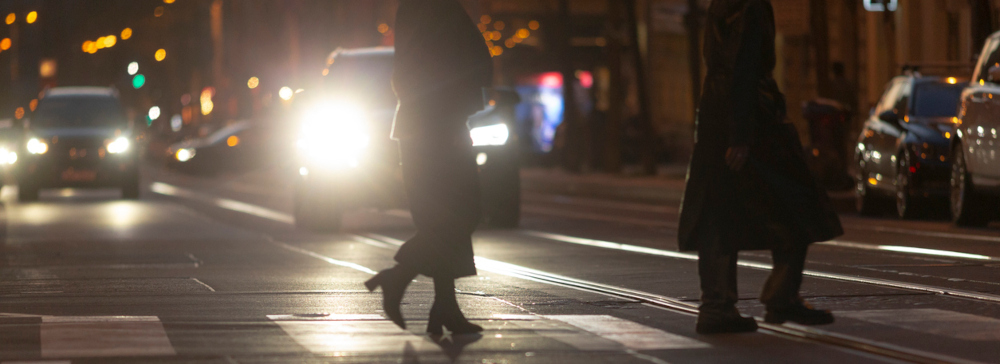
While drivers have a legal duty to exercise “due care” for the safety of pedestrians, a pedestrian can be found partially at fault for an accident in several scenarios, including:
- Jaywalking: Crossing a street outside a designated crosswalk, especially if a crosswalk is available.
- Ignoring traffic signals: Crossing against a “Don’t Walk” sign or a red light.
- Walking into traffic: Suddenly leaving a curb or running into the path of an oncoming vehicle that is too close to stop.
- Distracted walking: Being distracted by a cell phone or other device and not paying attention to traffic.
- Failing to use reasonable care: A pedestrian is responsible for acting as a “reasonably prudent person” to ensure their own safety.
- Under the influence of alcohol or drugs and falling into the street: A person under the influence may not perceive where they should and should not walk.
A skilled pedestrian accident attorney understands how to investigate these factors, gather supporting evidence, and counter attempts by insurance companies to unfairly shift blame onto the victim.
Important Evidence in a Pedestrian Accident Case

The evidence in a pedestrian accident case may include:
- Accident scene photos and videos
- Surveillance video
- Eyewitness accounts
- Police reports
- Medical records
Expert witnesses, such as medical professionals, may testify about the severity of the injuries, your prognosis, and long-term care needs. In some situations, an accident reconstructionist will recreate the incident based on exact measurements of the scene, roadway design, the vehicle involved, and sophisticated data analysis.
Contact a Los Angeles Pedestrian Accident Attorney

If you or a family member was seriously injured in a pedestrian accident, you need the services of an experienced Los Angeles pedestrian accident lawyer at Salamati Law. Schedule a free, no-obligation consultation today. Because we work on a contingency basis, you pay no fee unless you receive compensation for your losses.